


The American ambassador to Malawi has defended the recent 44% devaluation of the kwacha, describing it as remedy towards achieving economic stability for the country.
The diplomat, David Young made the remarks in an exclusive interview at the Malawi Institute of Journalism on Wednesday.

He said the devaluation was necessary alignment towards stabilizing and growing the economy.
“The incredible divergence between the official and the unofficial exchange rate caused people to engage in butter trade, they were going outside the formal economy.
“Money, funding and projects were not being taxed, it was a dysfunction that could not be sustained,” he said.
If Malawi was to achieve realistic economic growth, he said, there was need to set up a growth strategy and also embrace more trade and investments.
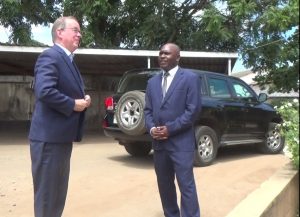
“The fuel shortages Malawi has been experiencing is because there is no forex in the economy , there is need for a reform program to grow the economy or Malawi is never going to move forward. “ Young said.
In May last year, government devalued the Malawi Kwacha by 25 percent in a bid to boost decreasing forex-reserves; a move also applauded by industry captains – the Malawi Confederation of Chambers of Commerce and Industry.
Lekani Katandula, President for the chamber of the commerce is on record as saying the recent devaluation was long overdue as the official exchange rate was completely misaligned with the market forces.
He said: “The situation made it very difficult to get money at the official rate as it became a penalty on exporters whose export earnings were mandatorily being converted at that official rate which was a very painful tax for exporters”.
However, economist Bond Mtembezeka argues the decision to devalue the kwacha needed to be treated with caution.

“Malawi imports more than it exports and little has been done to prop up exports, our currency has been losing value, in effecting the devaluation some elements need to be considered.
“Questions like what is the true value of the kwacha, what is the impact of a devaluation on the masses help to guide if a devaluation is worth pursuing or not” Mtembezeka explained.
Meanwhile, Young has also expressed optimism that the approval of a loan worth 174 million US dollars by the International Monetary Fund will help to solve Malawi’s economic challenges.
“The IMF agreement is part of a path to move towards a broader private sector with a growth model to help grow the economy.
“The Development Policy Operations of the World Bank has also approved 150 million dollars of funding and 80 million of that will help with the balance of payments and budget support,” Young explained.

Echoing Young, Betchani Tchereni an economics professor with the Malawi University of Business and Applied Sciences said the IMF loan provides hope to turn around the country’s economic misfortunes.
“This will boost international private sector confidence and unlock foreign direct investments and investments from multilateral institutions,” Tchereni said.
The 48 months loan from the IMF and granted under the Extended Credit Facility in November 2023 came a week after Malawi effected the 44% devaluation.
The loan is intended to support the authorities’ macro-economic adjustment and reform agenda in a debt ridden nation to promote economic recovery by boosting foreign exchange reserves and grant financing.
Commenting on prospects of resumption of direct budgetary support to Malawi in the wake of the cash gate scandal of 2014, Young said the US government remained committed to supporting Malawi.
“The vast bulk of our money will continue to be given in partnerships that we do with other organizations. Usually the US development assistance is done through partners and not direct budgetary support so we are not treating Malawi differently because that’s the model that we use in most countries,” explained the diplomat.

Meanwhile, Fadhel Kaboub, associate professor of economics at Denison University in America says Malawi needs to invest in food sovereignty, agro ecology, and renewable energy and higher value added manufacturing to turn around its economic misfortunes.
“Malawi suffers from an unsustainable external debt burden which is a symptom of three major structural problems; food deficit, energy deficit and manufacturing value added deficits.
“A weaker exchange rate means everything the country imports becomes expensive, this forces the central bank to borrow more dollars in an attempt to stop the currency depreciation. However when external creditors are not willing to lend dollars the only option left is to let the exchange rate further depreciate.
“This throws the country into a vicious cycle of inflation and shortages of essential items. The Structural solutions need to prioritize strategic investments in food sovereignty, agro-ecology, renewable energy and higher value added manufacturing, anything short of that is tantamount to neo-colonial entrapment” Kaboub said.
Malawi’s economy has been sailing through tough times characterized by an acute shortage of petrol and diesel, as well as high inflation, standing at 26.90% as of end October 2023.
Authorities have attributed the economic downturn on external factors, such as effects of the devastating cyclone Freddy which hardly hit the southern part of Malawi earlier this year and the war in Ukraine.
Real GDP growth is projected to increase to 1.4 percent in 2023, with shortages of foreign exchange still weighing on economic activity. Inflation is expected to average 30.3 percent in 2023 and to decline to around 7 percent in the medium-term.
