


Decades after political independence, many SADC countries including Malawi are still confronting the effects of economic colonialism. Now, a new form is emerging
As artificial intelligence reshapes global economies, experts warn of – algorithmic colonialism – where AI systems developed in the Global North, trained on foreign languages and foreign data, are deployed in Malawi and across SADC without regional control.
With most AI platforms operating primarily in English, indigenous SADC languages including Chichewa risk digital marginalization. If local languages are not intentionally fed into AI systems, the region may lose influence over the cultural and economic tools that will define future generations.
This report begins at the Malawi University of Business and Applied Sciences in Blantyre, where biomedical engineering student Lawrence Chisale struggles to build an artificial intelligence innovation in his native Chichewa, but is forced to code in English — highlighting how global AI systems risk excluding local languages.
Yet, beyond the classroom, the story follows farmers in Malawi using AI tools such as the Ulangizi chatbot in local languages, showing that inclusive artificial intelligence is possible when technology is adapted to African realities.
As the report expands from Malawi to across the SADC region, it highlights progress made by countries such as Malawi, Zambia, Mauritius and South Africa in developing AI strategies, but reveals that the region still lacks a unified policy framework — raising concerns about data sovereignty, foreign dependency and economic control.
This article by Georgia Mbaghugho Chirombo titled; Algorithmic Colonialism: How Malawi and SADC’S AI Policy Gap Threatens our Culture, Languages and Economy, is through the voices of students, farmers, economists and policy makers asking a key question.
Will Malawi and SADC continue to be shaped by artificial intelligence developed elsewhere — or will the region build a regional framework that safeguards its independence in the digital age?
This story starts from Mubas – Malawi University of Business and Applied Sciences, Malawi’s commercial capital; Blantyre.
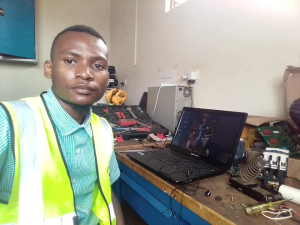
On a study errand, in a computer lab, Lawrence Chisale a third-year biomedical engineering student is using python programming, a high level language consisting of English-like instructions that instruct a computer exactly what to do, acting like a translator, coding words Chisale is using into numbers the machine can process.
His aspiration is to build a software that would enable a computer to analyze medical data and detect illnesses, a software that will use AI to study patient symptoms.
All things being equal, Chisale an African, would prefer any Bantu language but chiefly Chichewa; him being Malawian, but he’s caught in a dilemma; for, the machine can only code English.
This is the story of artificial intelligence, the emerging digital technology, it’s a story, beyond Mubas and beyond Malawi to across Sadc – Southern African Development Community.
“As a biomedical engineering student but also an aspiring innovator I have a dream of developing an artificial intelligence tool someday, however doing this is not easy, it needs knowledge of programming languages. However common programming languages such as Java and Python are in English, in my mind I think in Chichewa, so I struggle to understand what these programming languages want me to do,” Chisale said.
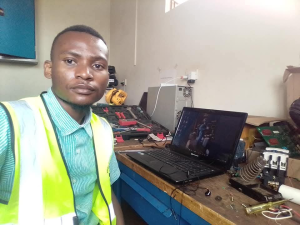
Away from students and the computer lab a bigger picture comes into play, a regional reflection of how Sadc integrates artificial intelligence moving toward a Digital Single Market.
The case of Chisale represents a challenge Sadc is facing in building a digital future in languages, cultures, and values within the region.
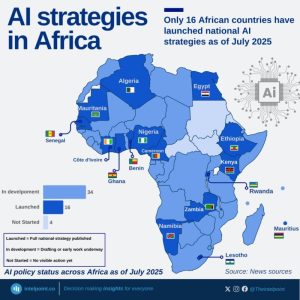
So far research shows that none among the 16 member-states has fully enacted a dedicated national AI law.
Of course there’s progress for a few namely: Malawi which has launched its draft National AI Strategy, Zambia launched it’s in 2024, reports also indicate Mauritius and South Africa too have made advances in developing their frameworks.
Yet in spite of these gains, studies show more than 90 % of AI training data focuses on English with less than 1 % covering Africa’s indigenous languages – underscoring the risk of digital exclusion.
Meanwhile some scholars are labelling this as “algorithmic colonialism”, they aren’t comfortable with AI systems being built in the Global North, trained on foreign data, languages, priorities and being deployed across Sadc economies.
In rural Malawi, another story is unfolding.
In fields once destroyed by Cyclone Freddy, armed with phones in their hands farmers like Alex Maere are scrolling through a chatbot called Ulangizi whilst another Anna Chimalizeni listens as the chatbot provides farming guidance in her vernacular language.

According to Maere, the Ulangizi AI Chatbot operating in Chichewa helps him access farming advice easily, which has boosted production and profitability of his business.
“When we joined the AI group we rented our farming fields and cultivated various crops including maize, we have been harvested enough even though they have been challenges we have registered success and invested in tomato faring which gives me hope for success,” Maere said.
Being used by about 180,000 rural households, the Ulangizi chatbot by Opportunity International Malawi is making inroads as being explained by Ronald Chongo country director for the institution.
“The good thing with this chatbot it provides response when you ask it by text, you can also ask using voice so it will return response through voice which is good for people who can’t read and write but it is also able to receive a question through pictures,” Chongo explained.
In South Africa, similar AI tools are helping farmers become more resilient to climate shocks. South Africa’s Agriculture minister John Steenhuisen thinks this is a game changer.
“With AI you can through a smartphone devise put an extension officer into the pocket of any small-scale farmer in the country, so I think AI can revolutionize the way agriculture works, particularly in assisting small scale farmers to be able to compete,” Steenhuisen said.

Such are inroads AI is making across the Sadc bloc, entering farms and Classrooms.
No wonder the Sadc Digital Transformation Strategy, identifies digital technologies including AI as critical enablers for socio‑economic development across the region, with targets to improve digital skills and infrastructure by 2030.
This is also collaborated in UNESCO’s reports which suggests that AI could contribute up to 2.9 trillion US Dollars to Africa’s economy by 2030, yet the continent currently captures only about 2.5 % of the global AI market.
Thus calls are emerging for a well-coordinated approach if the bloc is to lay foundation for long-term economic gains as being suggested by Bertha Chikadza, president of the Economics Association of Malawi – an economics’ think-tank.
“If SADC lacks the policy framework to build its own AI stack then it will face a triple economic loss such as licensing fees to OpenAI, Microsoft, Google and other platforms, but also costs of adapting western models to local contexts which will still require sending data back to foreign servers.
Overtime AI subscription payments will become the 21st century equivalent colonial loyalty payments. In countries already struggling with forex shortages such as Malawi, Zambia and Zimbabwe, this compounds macroeconomic fragility, “Chikadza explained.

Associate Professor of Economics, Fadhel Kaboub, president of the Global Institute for Sustainable Prosperity is cautious about these patterns of foreign dependency.
He warns of over reliance of AI built in the Global North arguing it risks reproducing a digital form of economic colonialism across Sadc.
“We are talking about a new frontier of digital colonization in the form of AI technology, so if the SADC region is going to rely on global north coded models and cloud stacks, we don’t just import software, we in fact invite foreign jurisdiction over African data sovereignty, where the date is stored, who can access it and under which legal jurisdiction we govern our data.
The commodity is now the African digital life, identity, behavior, health data, education, politics, all this packaged into data sets that can be monetized elsewhere and potentially weaponized against the African continent in the form of some surveillance and political influence and manipulation on the continent,” Kaboub said.
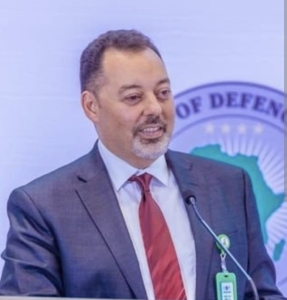
A tech entrepreneur Jerry Anguzu-Vance has reservations with Sadc chiefly importing AI systems.
He argues over-dependence on importation of AI systems risk exclusion of millions and above all rendering the region only a consumer in the AI value chain.
“The first thing we need to do is get players in the industry, especially the private sector because I believe it is the private sector which has to drive this kind of growth. We need to think of how we can start to annotate this languages so we have content in local languages. Another aspect to consider is how we can train the machines to use these languages,” Vance said.
Moving onward, Pan-Africanist Tuntufye Singoko says Sadc governments ought to draft a unified regional AI framework.
“It is very important that our leaders in SADC take steps to avoid a situation where we are left behind and truly become a slave of our own failure to move with time. We can rely on AI tools developed in other countries but how we protect our data matters. Government’s must work closely with the private sector to invest in knowledge, skills and infrastructure that would enable us become part of the AI transformation,” Singoko said.

And Chikadza can’t agree more, she says coordination for a harmonized Sadc AI framework is key.
“A harmonized policy allows SADC to implement the principle of data sovereignty, it also allows the region to reclassify certain types of data, for instance; agriculture, genomics, metrological and strategic national assets. We need to create asymmetry where data originates in Africa with regional AI research funding mechanisms, “Chikadza said.
Now, there’s some interesting data and revelation captured by the University of Cape Town in South Africa indicating that less than 5 % of African AI professionals are having relevant computing resources for advanced research.
To address this Kaboub suggests that artificial intelligence be treated as an industrial strategy at Sadc level.
“A unified regional AI policy has to be built like an industrial strategy, first we need to treat data and computing abilities as strategic resources not as [private capital for profit entities as a priority.
We need to define the data rights for communities and individuals, mandating transparency for high risk users and creating an Africa wide as well as regional wide set of rules for on cross boarder data flows,” Kaboub said.
The status quo lives Malawi and Sadc with some headache to remedy, how ready is the region to unlock this puzzle as we move together?
If only the bloc could build its digital future on its own languages, data and rules, students like Chisale will not just use artificial intelligence rather also create it.
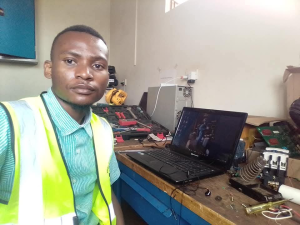
“When I finish school I need to create more innovations for Malawians, China uses AI in local languages, we as Africans we need to emulate these examples and I need to emphasize that SADC has to take this message seriously,” Chisale said.
Yes, Chisale’s dream must be Malawi and SADC’s aspiration of a united digital region not just a data colony.
