


A new page has been opened in the quest for improved gender and social inclusion policies in the implementation of climate change adaptation programs.
This is courtesy of the launch of Step Change Initiative at the climate summit underway in Sharma-El Sheik, Egypt.
It aspires to promote growth of equitable and inclusive locally led climate adaptation programs in the Global South.
The five-year project set to run from 2022-2025 is worth 28.5 million Canadian dollars and intends to promote justice in implementation of climate adaptation strategies by encouraging equitable access to adaptation finance.
The Step Change Initiative which is a partnership between Canada and the Netherlands is being jointly funded by the International Development Research Centre, IDRC and the ministry of foreign affairs of the Netherlands.
Speaking during the launch of the project, Dominique Charron, IDRC vice president, programs and partnerships said the project was key to improving resilience of communities affected by climate change.

“There is enough evidence of a worsening climate crisis, especially in low- and middle-income countries, this program is about using evidence decision making in these countries which is essential in building their resilience,” Charron said.
Besides, the initiative, according to her was vital in empowering local communities to take lead in development and implementation of climate adaptation projects.
“This program is vital in generating the momentum for locally led climate action,” Charron noted.
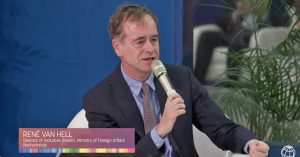
On his part, Rene van Hell, Director of Inclusive Green Growth and Ambassador for Sustainable Development at the Ministry of Foreign Affairs of the Netherlands said the project was essential in promoting the impact of the Climate and Development Knowledge Network (CDKN), a Southern-led network of climate knowledge brokers.
(Picture Credit: World Bank)
“This partnership is essential to promoting a previous partnership between Canada and the Netherlands by increasing support to the CDKN,” Hell said.
On her part – Shehnaaz Moosa, Chief Executive Officer for CDKN committed to providing support in advancing gender responsive and socially inclusive climate resilient programs by strengthening climate leadership and capacity.
“We are committed to deepen our impact and focus on community-led climate action that is both gender-responsive and socially inclusive. We are delighted to continue working with IDRC and the Dutch government for the next five years.” Moosa said.
Meanwhile, environmental campaigners have praised the introduction of the Step Change initiative, saying it was a game changer in the fight against impacts of climate change in vulnerable communities.
Kossam Munthali, a renowned natural resources campaigner and coordinator for Justice Link Network Malawi has told MIJ online the initiative was crucial to enhancing community mobilization in the fight against climate change and building resilience of developing nations like Malawi.
“Promoting locally inclusive, led approaches in implementation of climate adaptation programs is the way to go, if we are to build resilient communities, there is need for will power, this can only be achieved if communities are empowered to be at the forefront of this fight, “Munthali said.
He also said the project has great potential to promote rights of vulnerable groups such as women in implementation of climate adaptation programs.
Munthali explained: “This is a good initiative because it has gender lens approach so; it’s vital in addressing gender injustices, which vulnerable groups are facing as a result of climate change.
“Women especially in developing nations like Malawi have to walk long distances to fetch water because sources of water are drying up, so this program stands to address such issues,” Munthali explained.
Equally supportive of the project is Herbert Mwalukomo – executive director for Centre for Environmental Policy and Advocacy in whose observation said the Step Change was a game changer in promoting effective climate change adaptation programs.
He said: “This is a good initiative because there is need to build resilience, without community involvement, climate adaptation would be a difficult task to achieve.
“So the fact that this project has focus on the role of the is commendable but also the focus on gender is crucial in promoting women’s leadership in the implementation of adaptation programs,” Mwalukomo explained.
Meanwhile, at the current climate summit in Egypt (COP27), donor governments have pledged new funding amounting to 105.6 Million Us Dollars for Least Development Countries Fund (LDCF) and Special Climate Change Fund (SCCF) to finance urgent adaption needs in vulnerable nations.
The donors include; Denmark, Finland, Germany, Ireland, Slovenia, Sweden, Switzerland and the Walloon region of Belgium.
The new Pledges add to 413 million US Dollars that twelve donor countries pledged to the LDCF at COP 26 in Glasgow in 2021, thereby delivering the promises of the Paris Agreement, including providing adaptation finance for vulnerable nations which is a major topic of discussion at the current summit in Egypt.
*This article has been published with support from MESHA/IDRC grant for coverage of COP-27 by African science journalists.
