

By every measure and standard … safe and portable water must truly mean life. No wonder Malawi is party to multiple universal treaties to making safe and portable water accessible to all.It is also the reason why this commodity – water, is found in multiple national and universal documents.
But for some parts of the country this aspiration has just been on paper and remains there … with multitudes in some parts of the country sharing water sources with animals. However, in this feature story our reporters Robert Loka and Luke Magombo explores how best the revised Constituency Development Fund now pegged at 5 billion kwacha can serve the good of the country.
In the wee hours of a Monday, 46-year-old Feliya Austen is up already in Kapiza Village under Traditional Authority Lundu, Blantyre bordering Zomba.
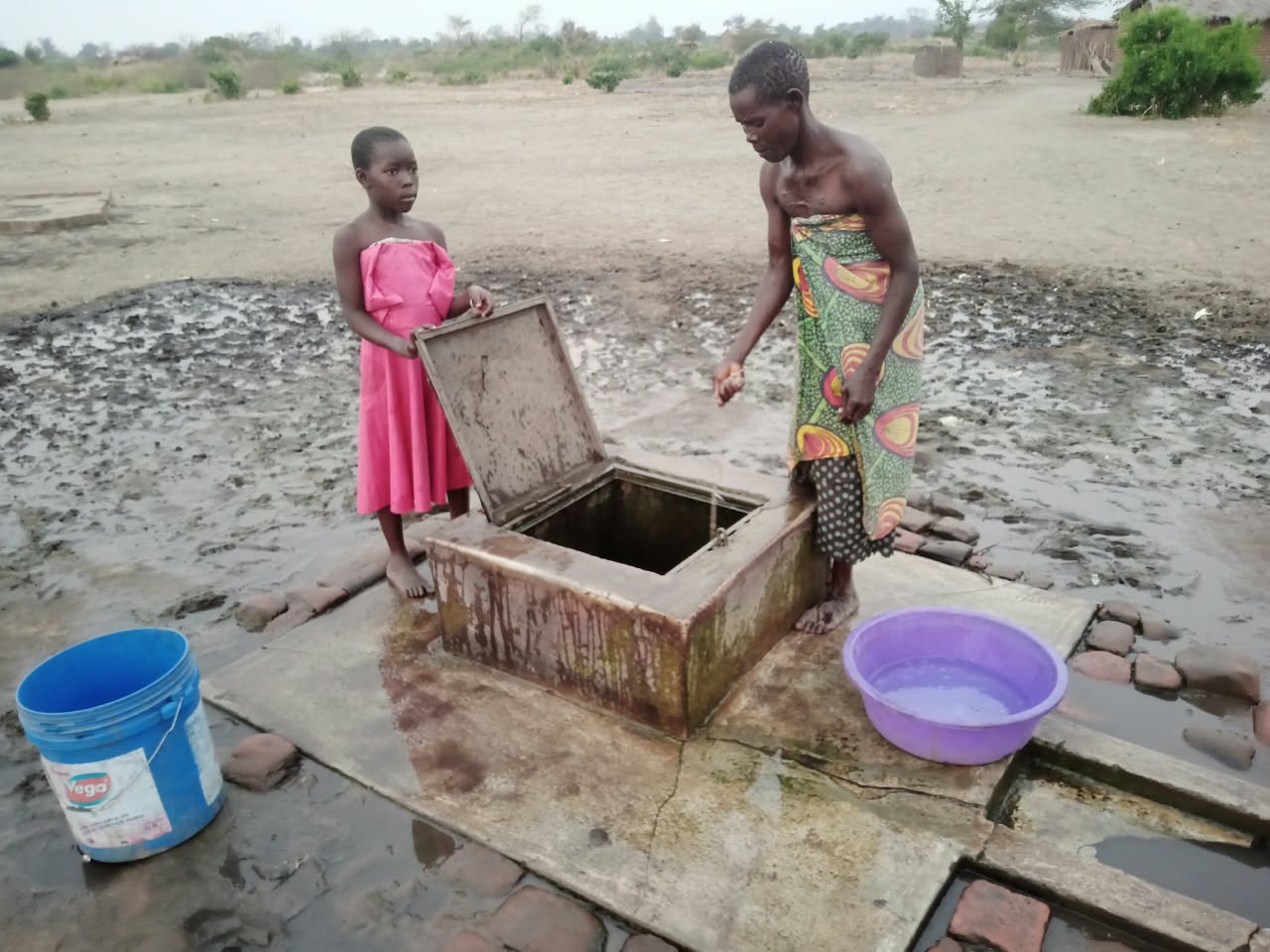
Don’t mistake this for a unique errand as Feliya just like other community members are used to waking up early trekking down a nearby dambo they have dug a well to draw water.
For her, this is the only option.
“We depend on this well as our main source of water, and people from surrounding communities also come here to fetch water. We use it for drinking, cooking, bathing and other household chores. Unfortunately, this is our only option because the nearest boreholes are too far away,” said Feliya.
Sadly; this well isn’t for Kapiza Village it as well serves communities surrounding: Kamwiri, William, Kapyepye, Zamanemba, Chatenga and Adam.
Ironically; this well isn’t only for humans.
Cattle, goats, and dogs aren’t a strange sight here. In what could best fit as ‘scramble for water’ here lies a well serving both mankind and mammals.
And this comes at a cost for this water is being consumed without treatment, a phenomenon feared as a leading cause of diarrhea cases in the area.
Feliya narrates the ordeal, “We frequently suffer from diarrhea, but we have no alternative and are forced to continue using the same water despite the health risks.”
This story isn’t exclusive to Feliya, it has collaborators like Maria Gelesani, from Zamanemba Village.
She says collecting water from the well isn’t a choice.
“We use this water for drinking and cooking, even though we know it is not safe. We have no other choice but to drink it,” she laments.
Maria tells an even darker side of this story with some people bathing from the source, making the water even dirtier.
“Sometimes, the water is visibly dirty, and we share the same well with cattle and goats. Despite these risks, we cannot abandon the well because we have nowhere else to get water. We are forced to use it, even when we know it could put our health at risk,” she said.
But there’s also a political side to this story as Group Village Head Chatenga observes. Each elections calendar comes with a promise for cleaner and safer water.
Years on! No political commitment, for cleaner and safer water is yet to come into fruition only the worsening water crisis.
Group Village Chatenga says, “Women scramble for water here, sometimes to the extent of fighting among themselves. Politicians only come to this community during campaign periods, making promises, but nothing tangible ever comes of them.
“At one point, they surveyed a site and confirmed the presence of water. They promised to return and begin drilling a borehole, but to this day, nothing has been done,” he said.
A long walk away from Traditional Authority Lundu many communities in Traditional Authority Kuntaja are faced with similar struggles.
Village Head Emily Leke for instance narrates how their years of waiting have turned promises of improved water access into frustration.
“We have been relying on stagnant water for a long time, and there has never been a borehole in our area. This is a major concern for us. Politicians have repeatedly promised to provide us with a borehole, but nothing has changed.
“We frequently suffer from diarrhoea because the water we depend on is also used by animals. Sometimes, people even bathe at the well, further raising concerns about water safety. We are living at risk because we have no alternative source of water” said Leke.
One would be tempted to think these challenges end in Traditional Authorities Lundu or Kuntaja. But no!
A Wash lobby group – Water and Environmental Sanitation Network (Wesnet) suggests these experiences reflect a wider challenge of the water supply situation in Malawi.

Safari Mbewe, executive director for the network observes access to safe water has remained a major obstacle on failure by authorities to consider this as a priority area.
“You will find that water, hygiene and sanitation are not taken as a priority at all. And this is what becomes critical. So whether the resources are there or opportunities are there, but you notice that water services are not being prioritized.
“So we need to reconfigure that kind of thinking where now water services have to be prioritized,” Mbewe said.
Ironically, this is in spite of Malawi committing to various universal instruments on making clean-and-safe water accessible to all by 2030 as per the Sustainable Development Goal 6 of the United Nations and the Malawi 2063.
On the other hand; UNICEF puts it that safe water has remained low at about 18 percent nationally and just 4.4 percent in rural areas.
Given such figures, does Malawi ever have chance to achieve access to basic water?
Dr. Kondwani Chidziwisano – an academic and researcher with WASHTED Research Centre at Malawi University of Business and Applied Sciences (MUBAS) feels such aspirations can only work if much effort is invested in WASH interventions.

“The current allocation of about 2% from the total national budget for WASH is not enough. There is a need to put more resources towards WASH-related interventions to make sure we have all necessary WASH facilities,” said Dr. Chidziwisano.
He adds, “Since the donor support that has been there is really shrinking at an alarming rate, we really need to prepare ourselves as a country as we move forward.”
On other hand, Mbewe from Wesnet considers the revised Constituency Development Fund now standing at K5 billion as a game changer.
However, he lobbies for clearer guidelines on water, sanitation, and hygiene.
“The issue is priority. Probably there is a lot of work that needs to be done to the communities so that they realize that WASH is a priority. Because even if the opportunities are there in the CDF, if the communities don’t see it as an opportunity, they will just be talking about, okay, let’s build a clinic, let’s build a school, let’s build this, without considering WASH services,” said Mbewe.
Echoing Mbewe, Dr. Chidziwisano proposes effective utilization of CDF to promote WASH initiatives which have often been given limited attention.
“I think having the CDF at constituency level is a great opportunity for the country to use. Previously, we were talking of limited resources. It is high time government should increase funding towards WASH, and that could be one way to achieve that.
“It could be a strategy that we may want to use, making sure that at each constituency, there is an allocation for WASH interventions,” said Dr. Chidziwisano.
On its end, government extends this scoop suggesting the need for equal investment towards hand-washing facilities which its access stands at 12 percent, against the aspiration of 75 percent to be achieved by 2030.
Mathews Kalaya, deputy director of sanitation in the ministry of health and sanitation shares this aspiration.
“I would say we have made some progress, but not much, because as of now we are still very far behind, only about 12% of households are meeting standards of basic hygiene. So you can see that there is still a long way to go.
“Mind you Malawi has a target of 75% to be reached by 2030. So the gap between 75% and the 12% is huge. So we need to do a lot,” said Kalaya.
For the people of Kapiza, Chatenga, Zamanemba and Lapani, these policy discussions are ultimately very personal.
They are about whether a mother can collect safe water without walking for hours, about whether a family can drink without worrying about falling sick. And whether children can grow up in communities where access to clean water is not a daily struggle.
For mothers in this story and countless others out there, the water crisis isn’t just a statistic report it’s the early morning walk, it’s the weight of a container over their head.
Time should be now that the multi-billion kwacha CDF brings answers to these rural communities who pay taxes, vote and struggle for life.
