
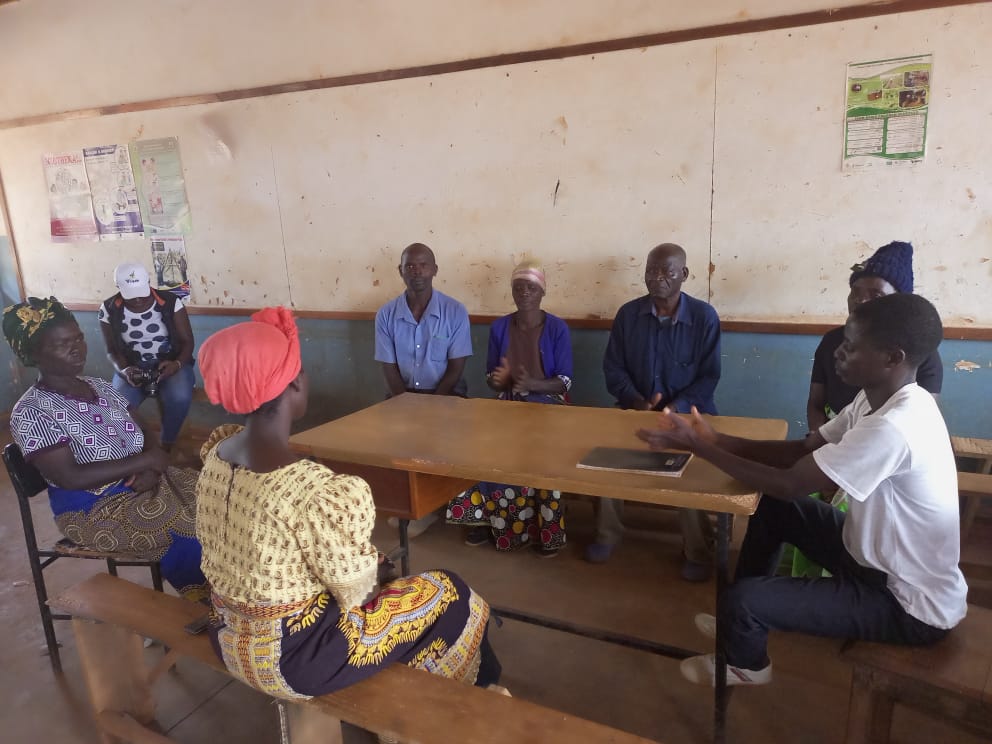

Farmers in Mchinji, have hailed the Farmer Business School model saying the learning sessions for Smallholder Farmers have contributed to increased production.
At farmer business school (FBS), farmers share knowledge about farm businesses, innovation in marketing, enterprise and pre- and post-harvest technologies.
A member of Kakuyu farmer business school in Masumba Village in Mchinji, Bwanasela Robert Kalamizu said through the School many farmers have graduated from subsistence farming to agribusiness.
“There are many gains. Through the farmer business school, we are able to share ideas on how we can increase production, get markets for our farm produce and how we can establish profitable agribusiness ventures,” said Kalamizu.
He said, they have a membership of 220 farmers and on that number, 90 are lead farmers who are also managing other farmers from their areas to make sure no farmer is left behind.
A lead farmer, Lickiness Yosefe from Katutula village, in the same district said, since extension workers cannot manage to reach out to all the farmers with expertise, farmers decided to come together so that those with enough knowledge can share with others.
She said, “In the past, farmers were farming for just consumption but now they are graduating to agribusiness and they are able to support their families with other needs, all thanks to the Farmer Business School.”
Transforming Agriculture through Diversification and Entrepreneurship (TRADE) Programme is encouraging the Farmer Business School model to fill the gap that is there between extension workers and farmers.
According to Oscar Ulili, TRADE’s knowledge and communications specialist, statistics show that one extension worker is supposed to reach out to 600 farmers.
“This is a big gap because one extension worker cannot reach out with expertise to all the 600 farmers. It is for this reason that we decided to come up with the farmer business school model.”

He added: “When the Lead farmer gets the expertise from the extension workers he/she should be able to share the knowledge with other farmers in their Areas. Each lead farmer has a minimum of 50 farmers, so this means the expertise from the extension workers is now getting to all the farmers in the communities, ‘’said Ulili.
Ulili said, from Farmer Business School, farmers are able to form cooperatives where they work as a team to achieve agribusiness.
TRADE Programme is a Government of Malawi 6-year initiative funded by the International Fund for Agricultural Development (IFAD) and Opec Fund for International Development (OFID) whose overall goal is to contribute to improved sustainable livelihoods of rural people in Malawi through Value Chain Commercialization and resilience of rural poor and smallholder producers.
