
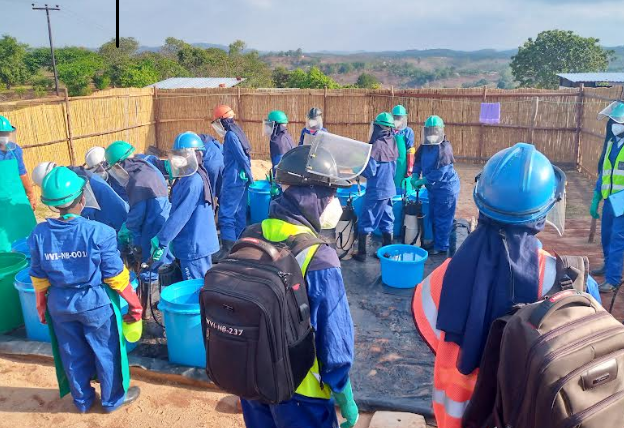

Health authorities in Nkhatabay have cited laxity among the populace to embrace health interventions as a key factor derailing the prevention of diseases in the country.
Nkhatabay just like Balaka and Mangochi has a high prevalence rate of Malaria in the country hence being listed to implement the Indoor Residual Spray-IRS project which is being funded by World Vision Malawi.
However, the initiative which seeks to reduce malaria cases a disease that account for about forty percent of hospital deaths in the country is said to be facing challenges of acceptance among the populace.
Speaking to MIJ Online, Trynomica Kalua IRS coordinator for Nkhata bay district observed that just like many other health intervention programs, unfounded myths and beliefs are countermanding their efforts of reaching their daily target of spraying about nine in every ten households visited.
“Our daily target is to spray in ten housing structures per officer but that is not happening as in some areas people are not welcoming our officers due to some myths and beliefs they hold” observed Kalua.
The reluctance according to Kalua is a result of infertility and deaths myths that are usually sprout when a new initiative comes into operation.
“Just like it was with Covid-19 vaccine, it is the same with this initiative as others fear it is a ploy to sterilize them while others think it is plan to kill them.” said Kalua.
However, as some residents of Nkhatabay are reluctant to have their homes treated with the said Malarial preventive drug, the case is not the same for one Charles Kanyanda Chirwa of Chiphika Village in the area of Traditional Authority Zilakoma in the district who has had his house spread since the inception of the project two years ago.
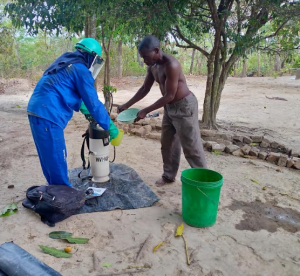
According to Chirwa, he no longer worries of his grandchildren getting sick of Malaria thus sparing time he could have spent taking care of the sick.
“I no longer worry about Malaria because of the IRS initiative and it is my plea to those objecting to have their house treated to reconsider because of the benefits of this initiative,” said Chirwa.
Meanwhile, it is therefore not surprising that with people like Chirwa around, the district has managed to reduce Malaria cases from one thousand one hundred and nine in 2020 to about five hundred cases in 2021 representing a fifty percent decrease.
It is therefore not surprising that council authorities in the district have employed every means possible to ensure that community members have their houses treated from engaging traditional and religious leaders to encourage their subjects to embrace the initiative.
According to Isaac Gondwe Director of planning in the district they are further advising community members to continue observing other Malaria preventive measures.
“What we want is to further reduce cases of Malaria and in that vein, we are encouraging people that have had their home spread not to abandon other malarial preventive measures like sleeping in treated mosquito nets among others,” said Gondwe.
In 2020 alone, Malawi recorded about seven million malaria cases that claimed 2,500 lives. Within the first year of World Vision’s Interior Residual Spray intervention, about 516,225 homes across three districts where the project is being implemented in Malawi were reached and in the process reducing malaria cases by half.
