
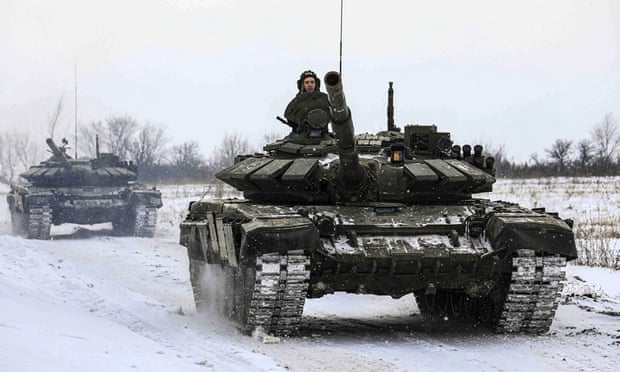

Russia’s defence ministry has announced it is to withdraw some of its troops from the border with Ukraine in a possible de-escalation of the threat of a potential invasion.
The size of the withdrawal remains unclear and may involve only a fraction of Russia’s forces at the Ukrainian border, which western officials estimate at more than 60% of the country’s ground forces.
The announcement of the withdrawal came in a statement from the defence ministry spokesperson Igor Konashenkov, who described ongoing exercises that involved forces from “practically all military districts, fleets, and the airborne forces”.
“Units of the southern and western military districts, which have accomplished their missions, are boarding trains and trucks and will head for their garrisons later today,” Konashenkov said in the statement.
The defence ministry also released a video of Russian tanks and other heavy weaponry being loaded on to railway cars, the Interfax news service reported. That footage appeared to have been shot in Crimea.
“Many statements are constantly being made from [Russia], so we have a rule: we’ll believe it when we see it,” said Dmytro Kuleba, Ukraine’s foreign minister. “If we see the withdrawal, then we will believe in de-escalation.”
A Kremlin spokesperson defended Russia’s right to hold exercises on its own territory and blamed Ukraine and western countries for escalated tensions.
“Our right to hold exercises on our own territory, wherever we see fit, is not to be discussed with anyone,” Dmitry Peskov told reporters during a briefing on Monday. “[The tensions] are provoked by US claims of a coming war.”
Russia’s rouble currency reportedly posted gains following the announcement, indicating that investors hoped this would mark the beginning of a de-escalation of tensions between Russia and the west.
Russia’s State Duma on Tuesday also voted to appeal to Vladimir Putin to recognise the independence of the two Russian-controlled separatist states in eastern Ukraine, a decision that would confirm the collapse of the Minsk agreement ceasefire signed in 2015 that stipulated their reintegration into Ukraine.
Lawmakers voted to approve a version of the bill submitted by Russia’s communist party, which would be sent directly to Putin for a potential signature rather than to the foreign ministry for consultations. It is likely Putin would use the bill as a bargaining chip, while demanding that Kyiv implement painful concessions from the Minsk agreements that have become political lightning rods in Ukraine.
Guardian News & Media Limited
