


South Africa’s governing African National Congress (ANC) is faced with a tricky dilemma which will determine the future of the country after it spectacularly lost its parliamentary majority in last week’s election.
Having won only 40% of the vote, the ANC needs to find a coalition partner to secure a majority in parliament which will support its choice of president and legislative plans – unless it tries to go alone with a minority government.
One option would be to strike a deal with the second biggest party, the centre-right Democratic Alliance (DA), which won 22% of the vote.
However this would be politically risky, as the DA’s critics accuse it of trying to protect the economic privileges the country’s white minority built up during the racist system of apartheid – a charge the party denies.
Alternatively, the ANC could work with two radical parties that broke away from it – former President Jacob Zuma’s uMkhonto weSizwe (MK) party or Julius Malema’s Economic Freedom Fighters (EFF).
These three parties share the same constituency, the black majority, and their combined vote comes to 65%. Mr Malema has warned the ANC against forming a coalition that would “reinforce white supremacy” and be a “puppet of a white imperialist agenda”.
This was a clear reference to a coalition with the DA, whose policies are diametrically opposed to the ANC’s, but they both agree on the need to uphold the constitution that South Africa adopted at the end of apartheid in 1994.
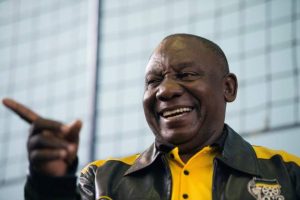
President Cyril Ramaphosa has made it clear that any coalition agreement would have to be within the framework of the current constitution.
One of the big obstacles to a deal is the DA’s fierce opposition to the ANC’s efforts to create a welfare state – especially a government-funded national health service, which the DA rejects, saying it is too expensive and threatens the future of the private health sector.
The DA believes in the free market, opposes a minimum wage, and wants to reduce red tape, saying this is the best way to improve the economy and raise living standards for all South Africans.
It is vehemently opposed to the ANC’s black economic empowerment policies, seeing them as discriminating against racial minorities while simply leading to the enrichment of the ANC’s business cronies.
Denying the allegations, the ANC has resolutely pursued these policies, arguing that they give black people a stake in the economy that they were excluded from during apartheid.
ANC chairman Gwede Mantashe has gone as far as to say the ANC’s black empowerment policies are non-negotiable, suggesting that he has ruled out a coalition with the DA.
But, according to some local media, President Ramaphosa is willing to enter into a coalition with the DA, believing that their policy differences could be overcome.
To overcome racial sensitivities, other parties – such as the mainly black Inkatha Freedom Party (IFP) and the Good party, which draws its support primarily from the coloured community, as people of mixed race are known in South Africa – could be included to form a Government of National Unity (GNU).
-BBC-
