
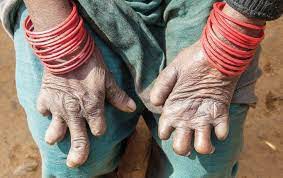

In the Biblical days; leprosy was understood as “a disease inflicted by God on those who transgressed his laws” – it was understood as “a divine retribution.”
Back then lepers were treated as an outcast; there wasn’t any cure for the disease and eventually, leper was left to disfigure through loss of fingers, toes, and limbs.
Years and years to follow … Malawi has seen a resurgence of leprosy; with many districts, and communities being affected and forcing authorities, stakeholders and communities into a war against the disease.

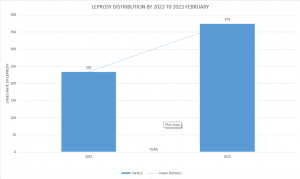
However, such infections of; 341 in 2018, 288 in 2020, 235 in 2022, and 372 by February, 2023 alone presents food for thought for a winning strategy against the disease.
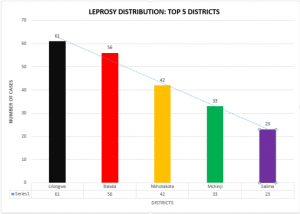
Irrespective of an equal-amount of attention and uniform amount of intervention Lilongwe district tops the chart with 61 cases by February 2023 alone followed by Balaka district with 56 cases according to the National TB & Leprosy Elimination Program.
Dr. James Mpunga, Manager for the program says Nkhotakota is third of the top-five districts with leprosy standing at 42 cases, followed by Mchinji at 33 and Salima district at 23 cases pitching the central region as the worse hit with the disease.
“Much as national figures continue to fluctuate within these ranges we consider the fight against leprosy as a mission in progress because the more we are identifying cases the more we are treating them,” he says.
Other interventions considered; the weight on the government to do more is huge not to mention but: upscaling surveillance, building community capacity , and mass awareness campaigns.
No wonder community leaders aren’t only pressing for active case-finding activities but also want empowered health surveillance assistants.
For group village head Chimowa of T/A Kalembo, Balaka district mass community engagements will empower locals to make early detection of suspected leprosy cases and raise timely alerts for early treatment.
“Our communities need awareness of signs and symptoms of leprosy. It will help a great deal. But we also need a strong health surveillance system, which we don’t have at the moment. Not at all surprising that Balaka is among the most affected districts in the country,” she says.
Echoing Chimowa; group village head Agabu in Ntcheu district draws his emphasis on multi-sectoral community engagement.
“If chiefs begin to use funerals or development gatherings … if religious leaders begin to use their gatherings and politicians too; the story will obviously be different. The fight against leprosy will take off once communities have become aware of signs, symptoms, and preventive measures of the disease,” he says.
Because; already there’re interventions in place; a public health expert, Professor Maureen Chirwa thinks the figures are a serious public health concern, which needs a clear strategy.
“I would suggest there’s a need to enhance surveillance on the disease, build the capacity of health workers and also educate masses about the disease; its signs and symptoms and preventive measures, says Professor Chirwa.
A similar observation is shared by Dingase Ngongonda, a public sector dermatologist according to whom “lack of skilled health personnel in remote areas is one weakness in the fight against leprosy as generally; rural health facilities lack the expertise to detect and treat these patients.”
Despite these suggested interventions; health workers raise their perspective.
A skin-and-sexually transmitted disease specialist, Henry Simeza thinks the management of leprosy is also being affected by proximity to borders for districts sharing national boundaries.
“There’s also a need to strengthen our borders because Malawi is also registering imported cases from countries like Tanzania because of the regular interaction between people of the two countries along the two borders,” says Simeza.
On surveillance and awareness; leprosy officer for Rumphi district Uma Mwamadi blames it on resource constraints.
He says resource limitations is limiting their efforts as health workers are restricted on mobility either for civic education activities or case detection inspections to communities.
And case tracking seems another challenge across the health delivery spectrum as some facilities are losing contact with patients to multiple challenges but not limited to cut-in-communication and mobility challenges.
Phillp Maunda a clinician at Mzuzu Central Hospital tells MIJ Online there’re hospitals that have lost track of their patients and cannot trace them either to communication break-down or mobility constraints – one key area also to address.
On the flip side though; there’re success stories too.
Hearing from some once-upon-a-time patients; leprosy isn’t a death sentence.
Sharing his testimony Mwai-wao Bonongwe from Kuchalawe village, Balaka district there’s hope for healing with medical attention.
“Am a living testimony of leprosy survival. You look at me; I’ve no single deformity I guess because I started treatment at the earliest stage of the disease and got cured.
“From my experience I’ll encourage people to seek medical attention upon noticing any symptoms of leprosy like skin patches and loss of sensation,” he says.
Leprosy remains a curable disease according to the World Health Organisation which lines out skin patches, nerve damage-and-loss of sensation, hand-and-feet damage and also damage to eyes among the most common symptoms.
