
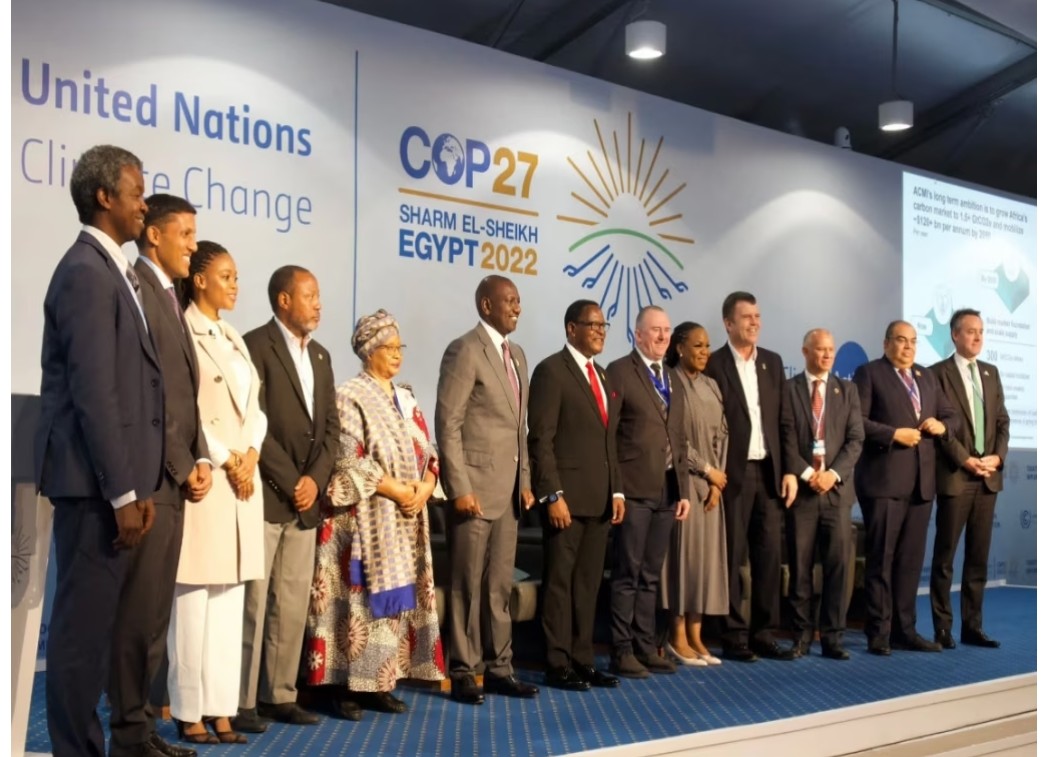

Malawi and other African nations have committed to work towards boasting production of carbon credits as means for unlocking billions of climate finance and creating millions of jobs.
A carbon market is a trading system through which countries may buy or sell units of greenhouse-gas emissions through carbon credits to meet national limits on emissions.
The pledge from African Nations follows the launch of the Africa Carbon Markets Initiative (ACMI) at the climate change summit (COP 27) currently underway in Sharma el Sheik Egypt with the aim of expanding Africa’s participation in voluntary carbon markets.
The AMCI project is expected to encourage production of 300 million carbon credits annually across the continent by 2030.
It also aspires to expand energy access, create 30 million jobs and unlock 6 billion in income for the climate finance needs of African economies.
For Malawi according to president Lazarus Chakwera the nation has potential to produce five million carbon credits which could rake in 100 million US dollars and support close to 250,000 jobs.

He said since 2015, Malawi has been undertaking various projects in the agriculture and energy sector with aim of building the ecosystem and that last year alone the nation -produced 600,000 tons of carbon credits.
“Malawi’s potential is huge and we have only scratched the surface, with opportunities ready to be unlocked in clean cook stoves and waste management solutions. We want to expand the projects and we will expand these projects,” Chakwera told delegates to the climate change conference.
He said the funds to be realized through generation of carbon credits would be used to improve lives of vulnerable Malawians through social protection programmes.
“This will help us to raise resources to support to over 3.8 million rural Malawians in need of food assistance due to climate change induced drought, also Malawi has a huge potential in production of clean cook stoves and waste management solutions which we are ready to explore,” he said.
Meanwhile, Dr Betchani Tchereni, an energy economist has told MIJ online that – Malawi’s partnership with the African Carbon Market Initiative was key to attracting green investments.
“This provides an excellent opportunity for the nation to attract green based firms, this implies that our economic activities will be meeting principles of sustainability,’’ Tchereni said.
He also said this was likely to deter the citizenry from purchasing emitting machines which was important to protecting the environment from greenhouse gas emissions at a time Malawi produces two million tons of carbon dioxide a year.
Also positive of the move is an agriculture policy think tank – Mwapata Institute whose executive director William Chadza has told MIJ online that carbon finance has great potential to stop deforestation in Malawi.
“Compensation for avoiding deforestation could help developing countries like Malawi to improve forest governance and boost rural incomes, while helping the world at large to mitigate climate change more vigorously.” Chadza said.
He also noted that Malawi and other African nations were yet to explore potential benefits of using forests to store carbon dioxide hence calling for sustainable forest management to be integrated into the global strategy for reducing greenhouse gas emissions.
Other African nations including Nigeria, Kenya, Gabon, and Togo have also shared their commitment to collaborating with ACMI to scale carbon credit production via voluntary carbon market activation plans.
According to Vice President of Nigeria and ACMI steering committee member – Yemi Osinbajo, Carbon markets can deliver tremendous benefits for Africa creating jobs, driving green investment, and reducing emissions.
“Nigeria is putting the groundwork in place today so that in subsequent years, carbon credits become a major industry that will benefit our people.” Osinbajo said
Also launching the African Carbon Market Initiative at COP 27, Kenyan President, William Ruto, noted that Africans have the potential to play a unique and significant role in the prevention and mitigation of emissions and the protection of crucial ecosystems.
“Globally, we have a golden opportunity to rapidly achieve these objectives, by developing a robust, transparent and sustainable mechanism through which a carbon credits market can yield attractive income and development opportunities for communities at the frontlines in the fight against climate change” Ruto said.
According to Ruto, it was crucial to develop modalities for proper valuation of existing carbon sinks before they fall for imminent threats such as deforestation and other forms of degradation.
In spite of carbon markets offering an opportunity to unlock billions for the climate finance needs of African economies, the continent currently produces only a tiny percentage of its carbon credit potential.
The African Carbon Market Initiative is working with major carbon credit buyers and financiers, such as Exchange Trading Group, Nando’s, and Standard Chartered, to set up an advance market commitment for hundreds of millions of dollars for high-integrity African carbon credits.
*This article has been published with support from MESHA/IDRC grant for coverage of COP-27 by African science journalists.
